Cleanup service
A Finished Basement Under Water From a Broken Line
Water always ends up in the basement. A line that breaks upstairs drains down through the floors, and a line that breaks downstairs has nowhere else to go. In a finished basement, that water lands on materials that were never meant to get wet from above or below: carpet over concrete, floating floors, and drywall framed right against the foundation.
Routing to a contractor near you can take a moment or two. Keep the line open until a person picks up.
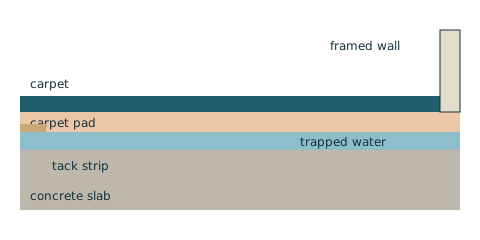
What Holds the Water Down There
Carpet and pad
The pad is where the water goes. It sits on the concrete, soaks up far more than the carpet, and can't be dried reliably in place, so it's almost always pulled. Carpet from a clean supply line may be dried and re-laid if it's caught early. Tack strip around the edges is often replaced too.
Laminate and vinyl plank
Click-together floating floors look fine from above while water sits underneath them on the slab. Laminate's core swells and the edges peak. Vinyl plank holds up better, but the water trapped beneath it doesn't dry unless boards are lifted. Expect some or all of it to come up so the concrete can dry.
Framed walls against the foundation
Basement walls are often a stud wall built in front of the foundation, with insulation between. Water wicks up the drywall from the floor and soaks the bottom of that insulation. These walls usually get a flood cut so the cavity and the concrete behind it can dry.
The furnace and water heater room
Usually unfinished, so it dries quickly, but check the bottom of the furnace and any stored items. If the water heater itself was the source, see appliance and supply line leaks.
Boxes, bedding and stored things
Cardboard collapses and wicks water into whatever is inside. Get boxes onto a dry floor upstairs, open them, and spread out anything with sentimental value so it can air out.
Concrete Holds Water Longer Than It Looks
Once the carpet and pad are out, a slab can look dry within a day, but concrete absorbs water and releases it slowly. Putting new flooring down over a damp slab traps that moisture. The contractor takes readings on the concrete as well as the framing and keeps the dehumidifiers running until both reach target. How long that takes depends on the materials and conditions; the article on how long drying takes after a burst pipe explains what moves the timeline.
Things You Can Do While You Wait
With the main shut off and the power off to any wet outlets:
- Lift furniture off wet carpet and put foil, plastic lids or wood blocks under the legs so stains from the finish don't transfer.
- Pin up curtains and bed skirts so they don't wick water.
- Move rugs, electronics and anything made of particleboard upstairs.
- If the water is shallow and there's no electrical risk, a wet-dry vacuum helps. A household vacuum doesn't, and it's an electrical hazard.
- Keep the heat on in winter. A cold basement dries slower, and turning off the furnace can put other pipes at risk.
Basement Bedrooms During Drying
Plenty of Layton homes have bedrooms downstairs. Drying equipment is loud and runs continuously, and the room may have open walls, so most families move whoever sleeps down there for the duration. Ask the contractor which rooms need to stay closed and which can be used.
Before the Carpet Comes Out
Photograph each room with the water still in it, including the height of any water line on the walls. Insurance adjusters sometimes ask for a sample of the carpet and pad, so ask the contractor to keep one before disposing of the rest. As with any job, get the contractor's Utah license number and look it up with DOPL, and ask for proof of insurance.
Basement calls come from both sides of town, from the foothill homes in East Layton to the neighbourhoods west of I-15 in West Layton. If the water in your basement came from a line that froze, the frozen pipe burst page covers where it likely started. The drying process itself is on the extraction and drying page.
Basement Questions
Should I run my own fans and dehumidifier until the contractor arrives?
It doesn't hurt, as long as nothing is plugged into a wet outlet or sitting in water. Household units won't keep up with a flooded basement, but they help a little while you wait.
Does basement drywall have to be cut every time?
No. If the water was shallow, caught quickly and the readings stay low a short way up the wall, the drywall can sometimes be dried in place with the baseboards off. The readings decide.
Can the rest of the basement be used during drying?
Usually, as long as you stay clear of open walls and leave the equipment where it's placed. Doors may need to stay closed to keep the dehumidifiers working on the right space.
Wet Basement in Layton
Routing to a contractor near you can take a moment or two. Keep the line open until a person picks up.