Cleanup service
When a Frozen Line Splits and the Thaw Floods In
Most freeze bursts are found the morning after, not the night of. The pipe splits while it's full of ice, the ice holds the water back, and the leak only starts once the wall warms up. By then the water has usually been running inside a cavity for a while before anything shows on the surface.
Routing to a contractor near you can take a moment or two. Keep the line open until a person picks up.
Why the Leak Starts After the Cold Breaks
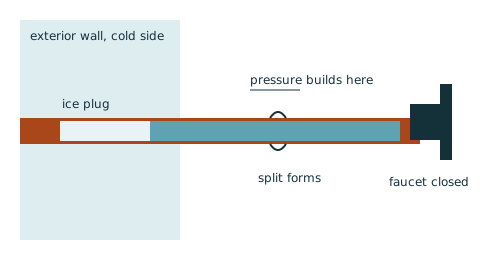
Water expands as it freezes. In a pipe, the ice plug forms first at the coldest spot, and the water trapped between that plug and a closed faucet has nowhere to go. Pressure builds in that stretch, and the pipe gives at its weakest point, which is often a few feet away from where the ice actually is. That's why the split is sometimes in a warm-looking part of the wall.
Different pipe materials fail in different ways:
- Copper tends to split along its length, leaving a thin bulged seam that sprays once the water's back on.
- PEX tubing can stretch and recover, so the tube itself often survives. The fittings, valves and manifold connections are the weak spots. The article on whether PEX will burst if it freezes goes into where it actually fails.
- CPVC gets brittle in cold and can crack outright, sometimes at a joint.
- Galvanized steel, still found in some older houses, can split at threaded joints where the wall is already thin from corrosion.
Where Layton Lines Usually Freeze
January nights in Layton commonly sit in the low 20s, and a lake-effect storm off the Great Salt Lake can drop temperatures hard with little notice. The lines that freeze are almost always the ones with cold air on one side:
- Supply lines in exterior walls, especially behind kitchen and bathroom sinks
- Plumbing running through a garage ceiling or a wall shared with an unheated garage
- Pipes over cantilevered floors and bay window bump-outs, where the floor hangs past the foundation
- Lines along the rim joist in a basement, where the framing meets the top of the foundation wall
- Crawl spaces with open vents or missing insulation
- Frost-free spigots that had a hose left attached, which keeps water in the part of the valve that's supposed to drain (why a frost-free spigot can still split)
- Sprinkler backflow preventers that weren't drained after the secondary water season ended (sprinkler backflow freeze damage)
Homes left with the heat turned down during a holiday trip are a regular source of these calls. So are vacant rentals between tenants.
Frozen but Not Leaking Yet
If a faucet gives nothing, or only a trickle, during a cold snap, the line is probably frozen and may or may not have split. Before warming anything, find the main shutoff so you can close it quickly if a leak appears.
During the January 2023 cold snap, Utah city officials advised letting faucets drip at about the width of a pencil lead and thawing frozen sections with gentle heat such as a hair dryer. Open the faucet on that line first so melting water has somewhere to go, and warm the pipe working back from the faucet. No open flame, no torch, and no space heater left alone near the wall.
If water appears anywhere while you're thawing, close the main. That's the split announcing itself.
Once It's Split and Running
Shut the main, then look beyond the obvious puddle. A freeze split inside an exterior wall often drains down the inside of the cavity, so the first visible water may be a floor below, in a basement ceiling, or along a baseboard in the next room. Note every spot you find. Those notes help the contractor decide where to start metering.
A plumber repairs the line. The cleanup work can begin as soon as the water is off, without waiting for the repair.
What the Cleanup Contractor Does on a Freeze Job
Freeze bursts are mostly cavity work. The mitigation tech typically:
- traces the wet area with a moisture meter and a thermal camera, which shows damp drywall as a cooler patch on the screen;
- opens the wall at the break so the plumber can reach the pipe and the cavity can dry, usually with a cut a little above the highest wet reading;
- pulls soaked fiberglass batts, which hold water against the framing and won't dry in place;
- checks the floor below, since basement ceilings and finished lower walls often caught the runoff;
- sets air movers and dehumidifiers, then returns to take readings until the framing reaches its dry target.
If the water reached a ceiling, the decisions on that page apply too: see ceiling and wall water damage. If it collected downstairs, see basement water cleanup. The drying itself is explained on the extraction and drying page.
Before Anyone Opens a Wall
Take wide and close photos of the wet areas first, while everything is still in place. Then ask the contractor for a Utah license number and a certificate of insurance, and look the license up with the Division of Occupational and Professional Licensing (DOPL). Keep in mind that a general building license in Utah doesn't cover plumbing, so the person fixing the split pipe needs the right license for that part of the job.
If you're on the foothill side of town, the East Layton page covers that part of the coverage area.
Frozen Pipe Questions
Can a pipe that thawed without leaking still be damaged?
Yes. A fitting can crack partway and hold for a while, or a copper section can bulge without opening. After a hard freeze, run the water on that line and check along it, under the sink and at the floor below over the next few days. A slow drip from a weakened joint is easy to miss.
Does homeowners insurance treat freeze bursts differently?
Often it does. Some policies limit coverage for freezing if the home wasn't kept heated or the water wasn't shut off and drained, particularly in a vacant house. Read your policy and talk to your agent. Burst pipes and homeowners insurance in Utah lists the usual questions to ask.
Why is the split in a different spot from where the pipe was coldest?
Pressure builds in the water trapped between the ice and the closed end of the line, so the pipe fails at its weakest point in that stretch, not necessarily where the ice formed.
Cold Snap Over, Wall Still Wet
Routing to a contractor near you can take a moment or two. Keep the line open until a person picks up.