Cleanup service
Pulling the Water Out and Drying What's Left
Every burst-pipe job has the same two halves. First the liquid water comes out. Then the water that soaked into wood, drywall and concrete is pulled out as vapour. The first half takes hours. The second takes days, and it's the part that decides whether the house ends up truly dry or just dry to the touch.
Routing to a contractor near you can take a moment or two. Keep the line open until a person picks up.
Extraction Comes First
Removing water as a liquid is far quicker than evaporating it, so the more that comes out with the extractor, the shorter the drying. On carpet, the contractor uses a wand or a weighted tool that the tech stands on to squeeze water out of the carpet and pad. Hard floors get squeegeed and vacuumed.
Truck-mounted extractors are powerful and stay outside with hoses run in. Portable units go where hoses can't reach easily, such as upper floors and condos. Either way, the aim is to get the floor from wet to damp before the drying equipment goes in.
The Equipment and What Each Piece Does
| Equipment | What it does | Where you'll see it |
|---|---|---|
| Pin moisture meter | Measures moisture inside wood and drywall through two small pins | Baseboards, framing, trim |
| Pinless meter | Scans the surface to find wet areas without marking it | Walls, floors, cabinets |
| Thermal imaging camera | Shows temperature differences; evaporating water shows as cooler patches | Ceilings, walls, finding where water travelled |
| Thermo-hygrometer | Reads air temperature and humidity to work out how much moisture the air is holding | Each drying room and outdoors |
| Air movers | Push air fast across wet surfaces so moisture leaves the material | Along walls, under cabinets, across floors |
| LGR dehumidifier | Pulls water out of the air; works well in normal room temperatures | Most rooms |
| Desiccant dehumidifier | Pulls moisture with a drying wheel; works in cold spaces and on dense materials | Cold basements, hardwood, crawl spaces |
| HEPA air scrubber | Filters dust from tear-out | Rooms where drywall or insulation was removed |
Why Layton's Dry Air Helps Less Than You'd Expect
Northern Utah air is dry for most of the year, so it's tempting to open windows and let the house air out. In winter, though, cold outdoor air holds very little moisture to begin with, and a closed-up basement holds onto its own humidity. Opening windows in January mostly chills the room, which slows evaporation.
The tech settles this with numbers rather than guesses. A thermo-hygrometer reading inside and outside shows how many grains of moisture each pound of air carries. If outdoor air is genuinely drier and the temperature works, ventilation can help. Most of the time in a Layton winter, sealed rooms with dehumidifiers dry faster.
A Drying Job, Read From the Log
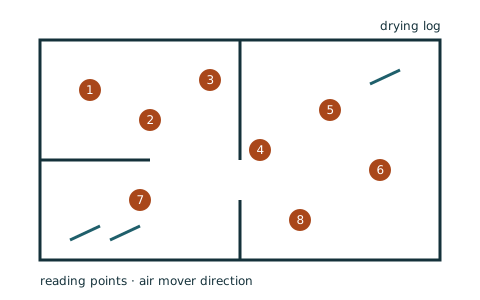
Setting up the log. On the first visit, the tech marks reading points on a sketch of the affected rooms and takes a reading at each one. A reading is also taken on unaffected material of the same type elsewhere in the house. That reading becomes the target, sometimes called the dry standard.
Sizing the equipment. The IICRC S500 standard groups jobs into classes by how much evaporation is needed: a small area with little soaked material is a low class, while wet ceilings, walls and dense flooring push it higher. The class and the room size guide how many air movers and dehumidifiers go in.
Each check-in. The tech returns, re-reads each point, records the numbers, empties or checks the dehumidifier drain lines, and moves equipment from areas that are drying well to areas that are lagging. Readings that stall usually mean water is trapped somewhere, under flooring or behind a cabinet, and that spot gets opened up.
Signing off. Drying is finished when every reading point reaches the dry standard. That's when equipment comes out and rebuild can begin. Ask for a copy of the log; it's useful for an insurance claim and for any later question about whether the house was dried properly.
Subfloors, Hardwood and Cabinets
Some materials need extra attention. Hardwood can cup as it absorbs water, and drying it slowly with specialised mats or covers gives it the best chance of flattening back out. Plywood or OSB subfloor under vinyl plank may stay wet until the flooring is lifted. Base cabinets trap water underneath them; removing the toe kick lets air in without pulling the cabinet.
Living With the Equipment
The units are loud, run continuously and give off heat, and several of them on one circuit can trip a breaker. Leave them where they're placed, don't turn them off overnight, and keep doors closed if the tech asks. Rooms are closed off so the dehumidifiers work on a smaller volume of air.
Whatever got wet, this drying process sits underneath it: freeze bursts, ceilings and walls, basements, appliance leaks, mold checks and rental or commercial units. For how timing works and why speed matters with "clean" water, read how long drying takes after a burst pipe and is water from a burst pipe clean?
Before you sign anything, check the contractor's Utah license with DOPL and ask whether they work to IICRC S500.
Extraction and Drying Questions
Why is the room so warm with the equipment running?
Dehumidifiers and air movers give off heat as they run. A warmer room actually helps, because warm air carries moisture away from materials faster.
What does "dry standard" mean?
It's the moisture reading of the same kind of material in a part of the house that never got wet. Drying aims to bring the wet materials back to that reading, rather than to a number on a chart.
Do the dehumidifiers need to be emptied?
Most units used on drying jobs pump water out through a hose into a sink, tub or drain. If a hose comes loose or a unit stops, let the contractor know.
Get the Water Out in Layton
Routing to a contractor near you can take a moment or two. Keep the line open until a person picks up.