Cleanup service
Water Coming Through the Ceiling or Down a Wall
A ceiling stain is the last thing to appear, not the first. By the time water shows through, it has usually run along a joist, soaked the insulation above, and spread across the back of the drywall. What you see from below tells you a lot about what's going on above it, if you know how to read it.
Routing to a contractor near you can take a moment or two. Keep the line open until a person picks up.
Reading the Ceiling Before You Touch It
A brown ring that's dry to the touch. Old or slow water. It may be from a leak that stopped, or one that's still feeding at a slow rate. Worth a moisture reading, not panic.
Bubbling or peeling paint. Water is sitting behind the paint film. The drywall underneath is wet and may be softening.
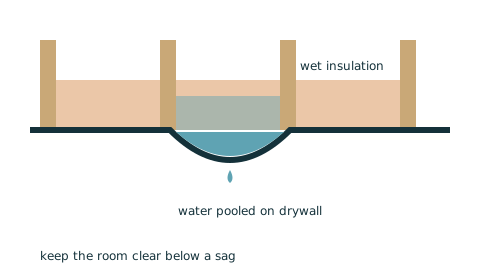
A belly or sag. Water has pooled on top of the drywall, and it's heavy. Keep everyone out from under it. If the bulge is small and you can reach it safely from a ladder, a screwdriver hole at the lowest point with a bucket underneath lets it drain in a controlled way. If it's large, close to a light fixture, or the drywall feels like wet cardboard, leave it alone and keep the room empty.
Water dripping from a light fixture or smoke detector. Turn that circuit off at the breaker panel, as long as you can reach the panel without standing in water. Don't flip the wall switch to check it.
The article on the first 30 minutes of a ceiling burst walks through the order of steps in more detail.
Where Ceiling Water Usually Starts
In two-story Layton homes, the usual sources sit right above the wet spot or a little uphill of it along the joists: a toilet supply line, a shower or tub valve, a vanity supply, the laundry room hookups, or a refrigerator line in an upstairs kitchen. A frozen line in an exterior wall can also drain down into the ceiling of the floor below. In condos and townhomes the source may be in the unit above, which brings in a second owner and possibly an HOA; the commercial and rental page covers that situation.
Stays Up or Comes Down: How the Call Gets Made
Drywall is gypsum pressed between paper. Once it soaks long enough, the gypsum softens and the paper loses its grip, and the panel won't regain its strength after drying. A ceiling panel that sagged, cracked or crumbles at the edge is coming down. A panel that stayed firm, with dry or reachable insulation above it, can sometimes be dried in place with air directed at it from below and, if needed, a small access hole.
Insulation tips the decision more often than the drywall does. Wet fiberglass batts on top of a ceiling hold water against the panel and add weight, so a ceiling with soaked insulation above it is usually opened so the insulation can be pulled.
Walls follow similar logic. Drywall wicks water upward from the floor, so the cleanup contractor marks the highest wet reading and cuts a straight line a little above it, called a flood cut. That's why the cut sits higher than the stain you can see. Baseboards come off so air can reach the bottom plate. Some houses have plaster rather than drywall; plaster holds up to water better but dries slowly, and is usually dried in place rather than cut.
None of this should be decided by eye. Ask to see the meter readings for any section marked for removal.
Drying a Wall Cavity
A closed wall dries very slowly on its own because no air moves through it. Once the wet sections are opened or vented, air movers push air across the exposed framing and dehumidifiers pull the moisture out of the room. Some contractors use cavity drying systems that blow air into the wall through small holes behind the baseboard, which can save drywall that's damp but still sound. How drying is measured and when it's finished is explained on the extraction and drying page.
Signs a Wall Is Still Wet Weeks Later
Paint that keeps bubbling, a baseboard that swells away from the wall, a soft spot when you press near the floor, or a musty smell in a closed room all point to moisture that didn't fully dry. Hidden pipe leak signs covers what to check, and if the smell is the main symptom, see mold checks after a leak.
Before Demolition Starts
Photograph the ceiling and walls as they are. Ask the contractor to sketch or photograph where the wet readings were taken, so you have a record of why each section was removed. Get their Utah license number and look it up with DOPL, and ask for a certificate of insurance.
Ceiling and Wall Questions
Can I just paint over the stain once it's dry?
Only if the drywall underneath is confirmed dry and solid. Water stains bleed through ordinary paint, so a stain-blocking primer goes on first. Painting over damp drywall traps moisture and the stain usually comes back.
Why was the wall cut higher than the water line I could see?
Drywall draws water upward through the gypsum, so moisture usually reaches higher than the visible mark. The cut is placed above the highest wet reading on the meter.
Will a textured ceiling match after the repair?
Matching an existing texture is part of the rebuild and depends on the skill of whoever does it. Ask the contractor handling the rebuild how they plan to blend the new section into the old one.
Wet Drywall in Layton
Routing to a contractor near you can take a moment or two. Keep the line open until a person picks up.