In most Utah homes with a basement, the main water shutoff sits where the water line comes in through the foundation wall, usually on the side of the house facing the street. Look in the utility or furnace room, under the basement stairs, near the water heater or water softener, or behind a small access panel in a finished wall. Find it now, test it once a year, and make sure everyone in the house knows where it is.
Where to Look in a Basement Home
The water service line runs underground from the street to the house and comes through the foundation below the frost line. Inside, the main shutoff is usually within a short distance of where that pipe enters. Start on the street side of the basement and work outward:
- The utility or furnace room. The most common spot, often low on the foundation wall near the water heater.
- Under the basement stairs. Builders often run the service line in here because the space is unfinished.
- Behind an access panel. In a finished basement, the valve may be hidden behind a small removable panel, a cabinet door, or a section of drop ceiling. Check closets on the street side of the house.
- Near the water softener or filter. These are usually installed close to where water enters, and the main is often just before them.
- In the garage. Some homes, especially those without basements, bring the line into the garage instead.
If you can see a pipe coming up from the floor or through the wall with a valve on it and the rest of the plumbing branching off downstream, that's almost certainly it. Some homes have two valves close together; closing either one stops the water.
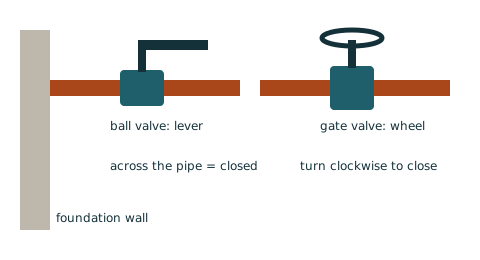
Ball Valve or Gate Valve
It's worth knowing which kind you have, because they work differently and fail differently.
Ball valve. It has a lever handle. A quarter turn closes it fully: when the lever lines up with the pipe, it's open; when it sits across the pipe, it's closed. Ball valves are quick, reliable and easy to tell at a glance whether they're open or shut.
Gate valve. It has a round wheel handle, usually takes several full turns clockwise to close, and is common in older homes. Gate valves that haven't been moved in years can seize, and the internal gate can break off and leave the valve stuck partly open. Turn an old one gently.
How to Test It
Once a year, ideally in the fall before the first hard freeze:
- Turn the valve off. Lever across the pipe for a ball valve; wheel clockwise until it stops for a gate valve.
- Open a faucet on the main floor. The flow should stop within a few seconds once the pressure drains.
- If water keeps running, the valve isn't sealing fully. Make a note to have it looked at.
- Turn the valve back on slowly, especially a gate valve. Opening it all at once can send a pressure surge through the pipes.
- Close the faucet and check the valve for drips around the handle once it's back on.
If a gate valve won't turn without serious force, stop. Forcing a seized valve can snap the stem or crack the body, which turns a test into a leak. A plumber can replace it, and many homeowners swap an old gate valve for a ball valve while they're at it.
The Valve at the Street
There's also a shutoff at or near the water meter, often called the curb stop. That one generally belongs to the water provider, and some need a special key to turn. Don't plan on using it in an emergency unless the utility has told you to. If the valve inside the house fails, call a plumber or the city's public works department.
Make It Easy for Everyone
- Hang a tag on the valve that says "Main water shutoff".
- Show everyone in the house who's old enough to use it.
- Keep the area in front of it clear, not buried behind storage boxes.
- If it's behind a panel, make sure the panel isn't painted or screwed shut.
- Write the location down for house sitters and tenants.
If You Can't Reach the Main in an Emergency
Close the closest fixture valve to the leak: the oval valve behind a toilet, the pair under a sink, the box behind the washer, or the cold supply on top of the water heater. That stops a single fixture while you keep looking for the main. It won't help with a split pipe in a wall, which is fed from upstream of all those valves.
Why This Matters in Layton
Many burst-pipe calls in Layton come during and just after cold snaps, when January nights fall into the low 20s and lake-effect storms off the Great Salt Lake push them lower. A frozen line in an exterior wall often splits overnight and only starts leaking when it thaws. The minutes between "the wall is wet" and "the water is off" decide how much drywall, insulation and flooring ends up coming out. The frozen pipe burst page explains how freeze leaks behave, and the home page walks through the first half hour after a pipe breaks.
If water is already in a Layton home in ZIP 84040 or 84041, calling (801) 788-4740 connects you with a local cleanup contractor. Keep the line open while the call routes.