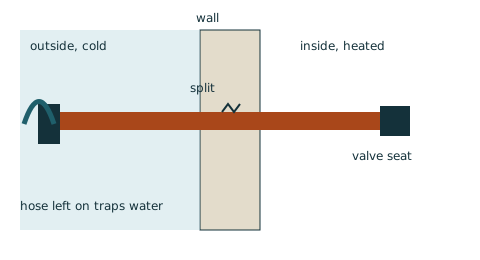
A frost-free spigot splits when water gets trapped inside its long tube and freezes. The most common cause is a garden hose left connected over winter, which stops the tube from draining. The split happens inside the wall, so nothing shows until spring, when you open the spigot and the water runs into the wall cavity or basement ceiling instead of out of the spout.
How a Frost-Free Spigot Is Supposed to Work
An ordinary outdoor faucet has its valve right at the outside wall, so the water sits in the coldest spot all winter. A frost-free spigot, also called a frost-free sillcock or hose bib, moves the valve inside the house. A long brass tube runs from the handle outside, through the wall, to a valve seat that sits in the heated part of the building, anywhere from several inches to more than a foot inside.
When you close the handle, the valve shuts at that inside end. The water left in the tube is supposed to drain out of the spout, leaving the part of the spigot that runs through the cold wall empty. Nothing to freeze, nothing to split.
The Three Ways It Fails Anyway
A hose left attached. This is the big one. A connected hose, especially one with a spray nozzle on the end, holds water in the tube instead of letting it drain. That trapped water sits inside the cold section of the wall, freezes, and splits the tube.
The spigot slopes the wrong way. The tube needs to angle slightly downward toward the outside so water runs out. If the spigot was installed level, or the house has shifted, water can settle in the tube even with no hose on it.
The inside end isn't actually warm. If the valve seat sits inside an unheated garage, a crawl space or an uninsulated rim joist, the "warm" end can freeze too.
Why You Don't Find Out Until Spring
The split is in the part of the tube between the valve and the outside wall. As long as the handle stays closed, water stops at the valve, upstream of the split, so nothing leaks all winter.
The first warm day comes, someone opens the spigot to fill a bucket or water the garden, and the water reaches the split. Some of it comes out of the spout, usually less than normal. The rest sprays inside the wall. Because the spout is still running, people often leave it on for a long time without realising half the water is going into the house.
Signs It Leaked Into the Wall
- Weak or sputtering flow at the spout compared with last year
- Water dripping from the basement ceiling, the rim joist, or the top of the foundation wall below the spigot
- Damp or stained drywall on the inside of that wall
- Wet insulation, or a musty smell in the room behind the spigot, in the days after it was first used
- A puddle on the basement floor along that wall with no obvious source
How to Test It Safely in Spring
Before the first real use of the season, take the hose off and open the spigot fully while someone stands inside, in the room behind that wall. If there's a ceiling panel or an unfinished section, look at the pipe and the rim joist directly. Listen for spraying or dripping inside the wall. If anything appears inside, close the spigot right away.
A split spigot needs replacing, not patching. That's a plumber's job, since the new one has to be sized to the wall thickness and set at the right slope.
If It Already Soaked the Basement
Close the spigot and, if water keeps coming, the main shutoff. Then look beyond the obvious wet spot. Water from a spigot split usually runs down the inside of the wall cavity, soaks the insulation at the rim joist, and spreads along the top of the foundation before it shows on the ceiling or floor.
In a finished basement, that means wet drywall and insulation behind the wall, possibly a wet carpet pad along the baseboard. A cleanup contractor checks the wall with a moisture meter, opens it where the readings call for it, pulls wet insulation, and dries the cavity. The frozen pipe burst page covers how freeze damage is handled, and ceiling and wall water damage explains when drywall can stay and when it comes down.
Preventing It Next Winter
- Disconnect every hose before the first hard freeze, and leave it off until spring. In Layton that usually means October.
- Look at the slope. The spout end should sit slightly lower than the wall end.
- An insulated foam cover over the spigot helps on exposed walls, but it doesn't replace taking the hose off.
-
If the spigot is on an older ordinary faucet rather than a frost-free one, close the indoor shutoff for that line, if there is one, and open the outside faucet to drain it.
-
If you're leaving the house empty for a winter trip, close the main and drain the lines, or keep the heat on at a normal setting. A cold house puts every exterior line at risk, not just the spigots.
Layton's January nights commonly fall into the low 20s, with harder cold snaps after lake-effect storms. That's well below what it takes to freeze a tube full of trapped water.
If a spigot split has put water into a Layton home in ZIP 84040 or 84041, calling (801) 788-4740 connects you with a local cleanup contractor. Keep the line open while the call routes.